A voyeur’s view of myth, desire, and summer
‘Bathers’ is an 'ode to the ultimate summer muse' - the bathing nude
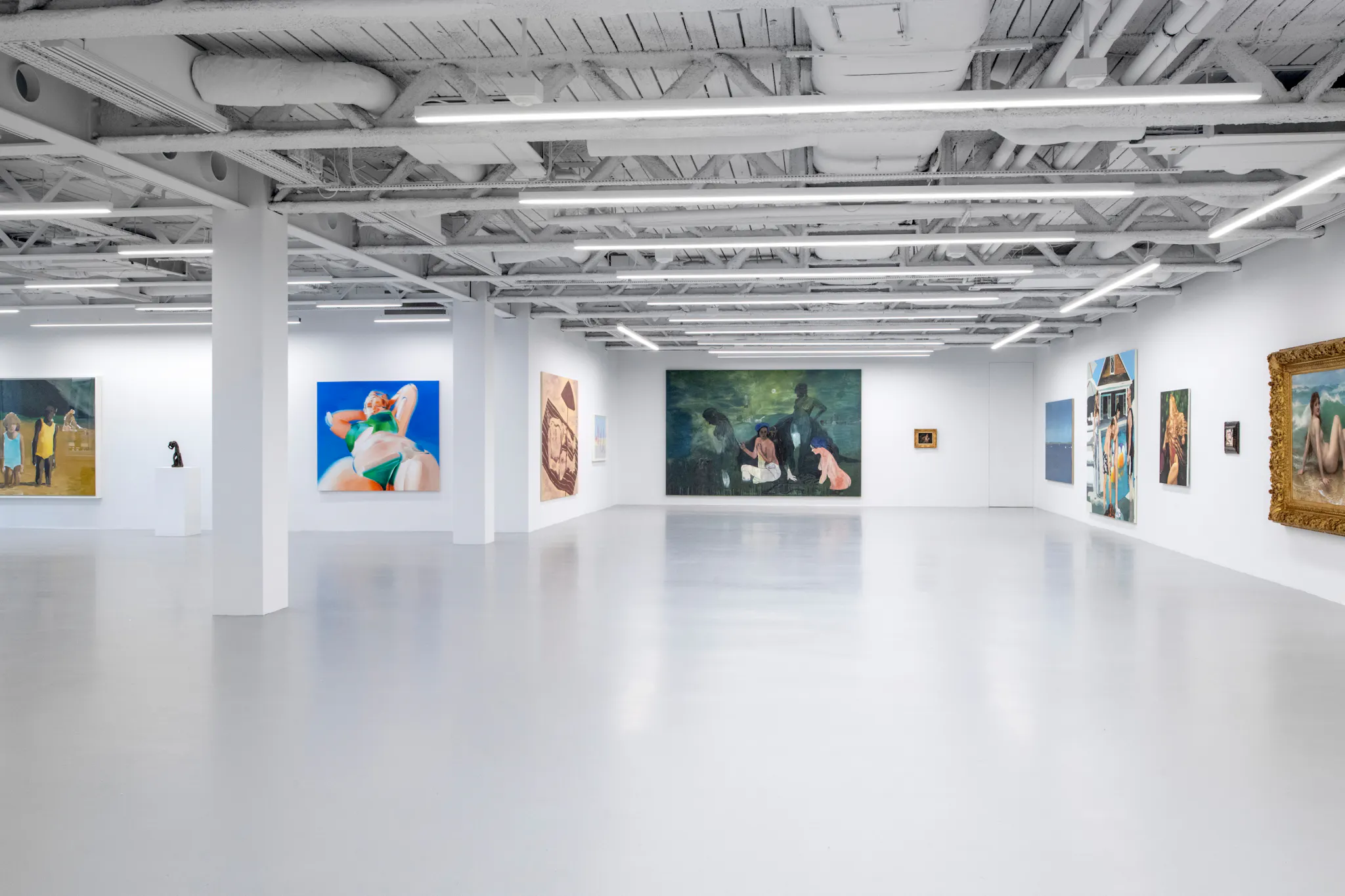
Landscape and the nude – two preoccupations that have fixated artists for centuries. Often straddling both subjects is the depiction of the bathing nude, which is rooted in the birth of Venus from the sea. The tradition, however, does not merely deal with ablution. Take, for example, Sandro Botticelli’s striking Birth of Venus (c.1484), Pierre-Auguste Renoir’s The Large Bathers (1884-87), and Pablo Picasso’s radical Bathing Nude (1908) – these iconic works are also linked to themes including voyeurism, purification, and birth. A new group show at Saatchi Yates’ new London space on 14 Bury Street in St. James – titled Bathers – explores the enduring and multi-layered subject of the naked bather by bringing together a major collection of contemporary art alongside renowned Post-War and historical masters such as Picasso, Paul Cezanne, David Hockney, Peter Doig, and Damien Hirst. The show, the gallery says, is “an ode to the ultimate summer muse.”
As you might expect, Saatchi Yates’ gallery space feels rather aquatic. There is water everywhere daubed in various mediums and wrought in metal, plaster, and formaldehyde. The paintings are like windows through which the viewer – or voyeur – peers at scantily clad or bare bodies drenched, dripping, or drying. The show is brimming with wanton desire; reclining subjects catch your eye, willing you to cast aside any inhibitions, undress, and jump in. French painter William-Adolphe Bouguereau’s La vague (1896), wrapped in a chunky gilt frame, holds a prominent place in the exhibition – it’s one of the earliest works and derives from the classical text The Birth of Venus. It shows an idealised naked figure (said to be the model Odile Charpentier) reposing before a breaking wave. The composition evokes a fantastical atmosphere and she’s looking directly at the viewer with a delicate grin, while her voluptuous pale body follows the beauty standards of the time.


It should be pointed out that the majority of artists featured in Bathers are or were men, and the majority of subjects are naked or semi-naked women, so the issue of the male gaze is integral. In recent years, Bouguereau’s work has come under increasing fire for its “patriarchal objectification of women,” and his fetishising of Venus is a case in point. On the contrary, the more recent works in the show, like Angela Santana’s Green Bather and Benjamin Spiers’ Natural Swimmer (both 2023), appear to celebrate the female form as opposed to leering from afar. The bathing nude has evolved.
Bouguereau had a classical academic background and was heavily influenced by Renaissance artists like Raphael. He worked with strict structure and composition rules – his work is known for its almost hyper-realistic portrayal of female beauty, unlike modern artists working at the same time who took a completely different approach. One of these modern artists was French Post-Impressionist painter Cezanne. His contribution to Bathers is the painting Nymphs and Satyrs (1867). It was created during his so-called “dark period” at the height of Romanticism when his palette was gloomier, his themes erotic and violent, and technique blunter (he often applied paint with a palette knife instead of a brush). It portrays a nymph being groped and ogled by two satyrs – the viewer is witnessing a sexual assault from afar. The work also places an emphasis on nature, a trait common in both Romantic painting and the subject of the bathing nude. Nymphs and Satyrs predates Cezanne’s celebrated Bathers (1898-05), which reimagined a classical subject in a modern, pictorial expression and greatly influenced future portrayals of the nude.

Picasso’s compact Baigneuse (1928) measuring just 19 x 24 cm follows the salacious tone of Bouguereau and Cezanne’s compositions. The Spanish artist explored the theme of the bather with increasingly expressive language and his focus on the motif may have been partly inspired by Cezanne, whom he greatly admired. Both artists painted – and returned to painting – the bathing nude to apply their own avant-garde visions against the conventions of painting, pushing the boundaries further and further towards symbolism. "Coming in the wake of Picasso’s Ingresque, Neo-Classical, sometimes almost photorealistic pictures, the raw expressivity of Baigneuse is bracing,” as Christie’s described the work when it was auctioned in 2012. “Here, the figure of a woman is shown as a form of landscape, her body demarcated with the mountain-like peaks of her breasts, her small head a peninsula receding into the distance, the focus on the expanse of open flesh in the foreground.” It is a striking combination of landscape and the nude. The painting is fittingly inconspicuous in scale – it is dwarfed by most of the other paintings – because it likely portrays his young lover, Marie-Therese Walter, whom Picasso hid from his wife and son.

Bathers maps the artistic evolution of the bathing nude through the ages and the show’s contemporary works by six artists on Saatchi Yates’ roster: British artists Danny Fox and Benjamin Spiers, Ethiopian artist Tesfaye Urgessa, Korean painter Sujin Lee, American artist Kottie Paloma, and Swiss artist Angela Santana. Cornwall-based Fox’s two painting in the exhibition are dark and mysterious. Bathers after Bosuns (2023) features eerie figures wallowing in murky water. The subjects are reminiscent of French post-Impressionist Paul Gauguin’s work but they are intertwined with menacing mythical creatures emerging from the depths. The water appears at once cold and uninviting yet strangely alluring, like the naked female figures themselves. Urgessa’s take on the topic – Bathers: Honey and Milk 1 and Bathers: Honey and Milk 2 (both 2023) – is more shocking; he has replaced water with blood, which is typical of his practice, which interrogates race and the politics of identity.
One of the sculptures on show is Damien Hirst’s Two Similar Swimming Forms in Infinite Flight (1993), a pair of baby sharks preserved in the artist’s characteristic formaldehyde and attached to a low metal hoop as if they are swimming in circles forever, frozen in time. It’s a more abstract take on the bathing nude theme. The sculpture may reference the act of birth and immortality, like that enjoyed by the goddess Venus, the matriarch of all bathing nudes.
Bathers
01 June - 10 August. Saatchi Yates, London.
Read More


Listen to audiocasts
 11 min 53s